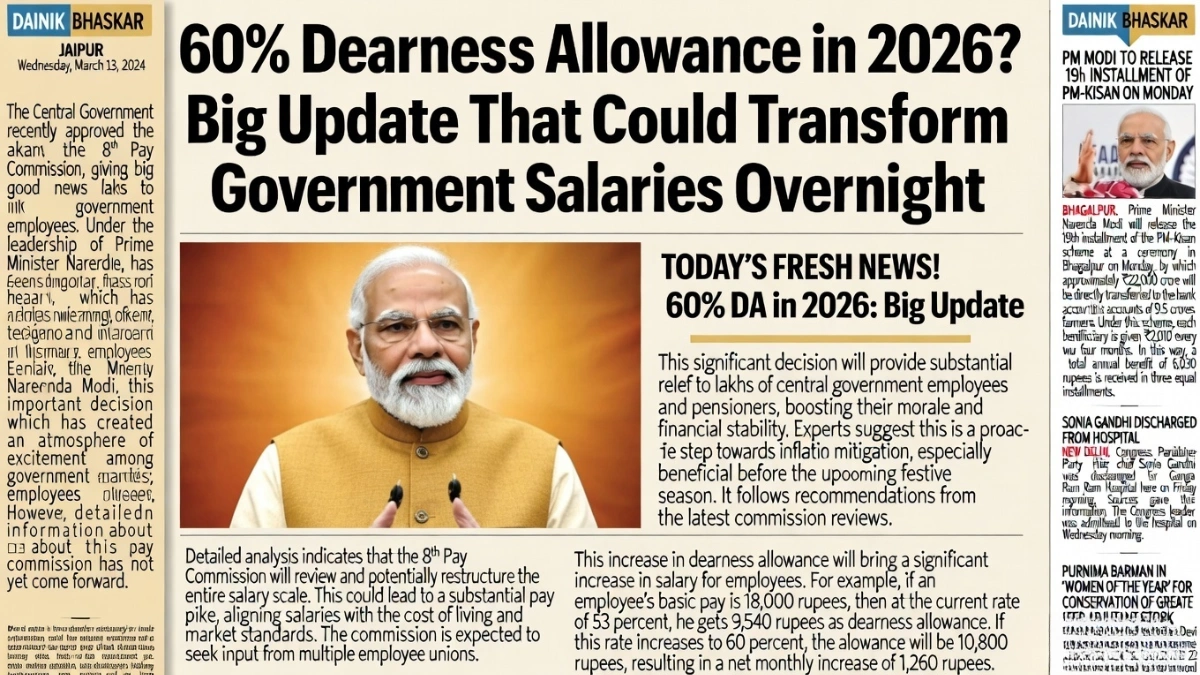
Government employees across India are closely tracking one major development that could dramatically impact their monthly salary in 2026. The buzz around a possible 60 percent Dearness Allowance has created massive curiosity among central government staff and pensioners. If this update turns into reality, it could mean a substantial jump in take home pay and retirement benefits.
The discussion has gained momentum as inflation trends, pay commission calculations, and government policy signals align in a way that makes the 60 percent DA mark look increasingly achievable. For millions of families dependent on government salaries, this is more than just a percentage. It is financial breathing space.
Why 60 Percent DA in 2026 Is Being Discussed
Dearness Allowance is revised twice a year based on the All India Consumer Price Index data. Over the last few years, rising inflation has steadily pushed DA upwards. Analysts believe that if current inflation patterns continue, DA could approach or even touch 60 percent by 2026.
The government typically announces DA hikes in January and July cycles. Each revision directly affects basic salary, pension payouts, and allowances linked to basic pay. If the upward trend remains consistent, reaching the 60 percent milestone is not unrealistic.
How 60 Percent DA Will Impact Salary
When DA increases, it is calculated as a percentage of the basic pay. A higher percentage means a direct rise in gross salary. For example, if an employee has a basic pay of Rs 40,000, a jump from 50 percent DA to 60 percent DA can significantly increase monthly income.
Here is a simplified example of how the difference may look:
| Basic Pay | DA at 50% | DA at 60% | Monthly Difference |
|---|---|---|---|
| 40,000 | 20,000 | 24,000 | 4,000 |
| 50,000 | 25,000 | 30,000 | 5,000 |
| 60,000 | 30,000 | 36,000 | 6,000 |
This increase also impacts HRA and other allowances in certain cases, depending on government rules. Pensioners would also benefit as Dearness Relief is linked to the same percentage.
Will DA Merge With Basic Pay Again
A key question employees are asking is whether DA will be merged with basic pay once it crosses a certain limit. Historically, under previous pay commissions, DA was merged when it crossed 50 percent. However, under the current pay structure, there is no official confirmation of such a merger in 2026.
If a merger happens, it could reshape salary structures and set the stage for the next pay commission recommendations. This possibility is fueling further speculation and excitement.
Key Reasons Employees Are Optimistic
Several factors are driving the positive sentiment:
- Continuous inflation pressure keeping CPI data elevated
- Regular DA revisions without delay in recent cycles
- Government focus on maintaining employee morale ahead of future administrative reforms
- Expectations linked to the upcoming pay commission discussions
These elements together create a strong case for a substantial DA rise by 2026.
Impact on Pensioners and State Government Staff
Central government employees are not the only beneficiaries. Pensioners receive Dearness Relief at the same rate as DA. A move to 60 percent would increase monthly pension payouts significantly.
State government employees may also benefit, as many states align their DA structure with the central government. However, the timeline for state-level implementation can vary.
What Employees Should Watch Next
The most important indicators will be upcoming CPI data releases and official announcements during the biannual DA revision cycles. Each percentage increase in 2024 and 2025 will determine how close the figure gets to 60 percent before 2026 begins.
Employees should also monitor discussions around the next pay commission, as structural salary changes often follow sustained DA growth.
Conclusion
The possibility of 60 percent Dearness Allowance in 2026 is more than just speculation. With inflation trends and past revision patterns in focus, the target looks achievable if current economic conditions continue. For government employees and pensioners, this could translate into a major financial boost and improved household stability.
While official confirmation is still awaited, the momentum behind this expectation is strong. The next few revision cycles will be crucial in deciding whether this big relief becomes reality.
Disclaimer: This article is based on current trends and publicly discussed projections. Final decisions regarding DA revisions depend on official government notifications.